

” data-title=”Farm in Odesa region abandoned sunflower – flax replaced it” data-url=”https://kurkul.com/news/41783-gospodarstvo-z-odeschini-vidmovilos-vid-sonyashniku–yogo-zaminiv-lon”>Farm in Odesa region abandoned sunflower – flax replaced it
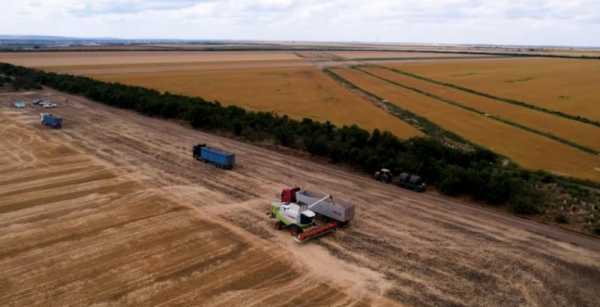
Latifundist.comHarvesting in the Odesa cluster of Golden Agro Holding, July 2026.
Winter crops dominate over 2 thousand hectares of the Odesa cluster “Golden Agro Holding” this year. Among spring crops, only flax is grown here. This is reported in the material on Latifundist.com.
Sunflower was consciously abandoned – under current climatic conditions, it no longer provides yields that would justify the costs.
“Technologically, we could not bring sunflower to a yield of 3 t/ha today. Economically, flax is almost the same now, but it depletes the soil much less in terms of moisture. And moisture is the main resource for us,” explained Oleksandr Shapoval, chief agronomist of the Veres company.
Next year, the cluster plans to expand its crop rotation. They are considering lentils, chickpeas, and coriander – crops that tolerate drought better and are good predecessors for winter wheat.
However, the agronomist is convinced that the main thing now is not to look for a new crop, but to learn to work with the soil. First of all, to accumulate moisture, improve soil structure, and develop microbiota. The goal is to have at least 220 mm of productive moisture in the meter layer and select crops that do not deplete these reserves.
“Sunflower and corn take too much moisture today,” he added.
Anatoliy Detochka, director and founder of Golden Agro Holding, also believes that the future of the steppe zone lies in simpler crop rotation: winter wheat, flax as an alternative to sunflower, and a cautious approach to rapeseed, the yield of which largely depends on whether it rains immediately after sowing.
“There are no such problems with wheat. Last year in September, it was already standing like a carpet – well tillered,” he noted.
By the way, wheat this year is being threshed with yields of 9.5–10 t/ha.
“We recalculated everything several times. We thought: this simply cannot be. But the combine confirmed – the numbers are real,” the farmer noted.
According to the agronomist, there is no single recipe for such a record yield. Everything worked together – a correctly selected variety, optimal sowing times, a nutrition system, protection, and, of course, the weather.
Read also: Alla Stoyanova: wheat yield of 4 t/ha for arid Odesa region is a record


© Yuliia Nemtseva, Kurkul.com, 2026.
Джерело новини: kurkul.com